Target Tracking with Obstacle Avoidance
How should a team of robots move to localize a moving target as accurately as possible, using only noisy distance measurements? In this project, agents equipped with range-only sensors track a moving target in an optimal formation, share their estimates with their neighbors, and do so in two challenging settings: under external disturbances acting on the agents, and in an environment with obstacles that must be avoided.
This was joint work with Milad Alipour Shahraki.
Approach
Optimal formation. Localization accuracy is measured by the determinant of the Fisher information matrix of the range measurements, which for \(n_a\) agents is proportional to \(\sum_{i<j} \sin^2\beta_{ij}\), where \(\beta_{ij}\) is the angle between agents \(i\) and \(j\) as seen from the target. It is maximized when two agents are perpendicular with respect to the target, and when three or more agents are spread uniformly on a circle around it. Each agent therefore follows a desired trajectory that circles the estimated target position, with phase offsets \(2\pi/n_a\) and a common angular velocity.
Distributed estimation. Each agent estimates the target’s position and velocity with an information-form EKF and fuses its information with that of its neighbors, so that no central processor is needed.
Tracking control. A Lyapunov-based feedback controller drives each agent to its desired trajectory. The tracking error converges to a small neighborhood of the origin when the estimation errors are bounded, and exponentially to zero when they vanish.
Rejecting disturbances
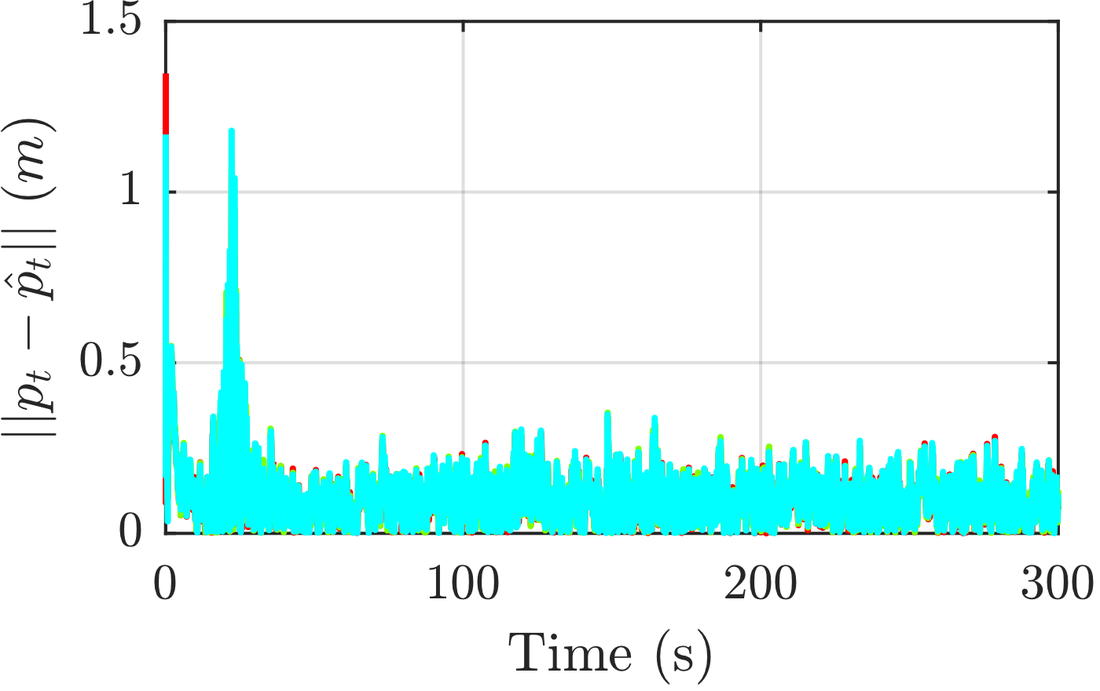
When external disturbances \(d\), with known linear dynamics \(\dot d = A d\), act on the agents, a second EKF on each agent estimates its own state together with the disturbance, and the estimate is fed back to the controller to cancel it. Without this estimate, the agents drift away from their desired trajectories; with it, they follow them closely and the disturbance estimation error quickly goes to zero.
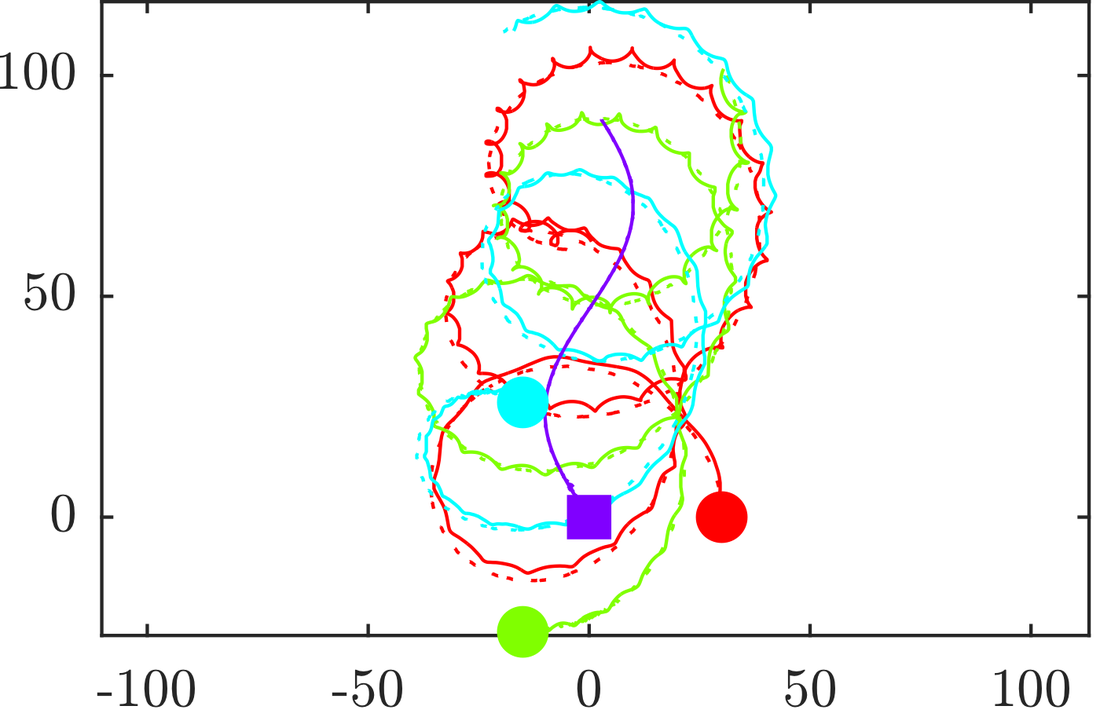
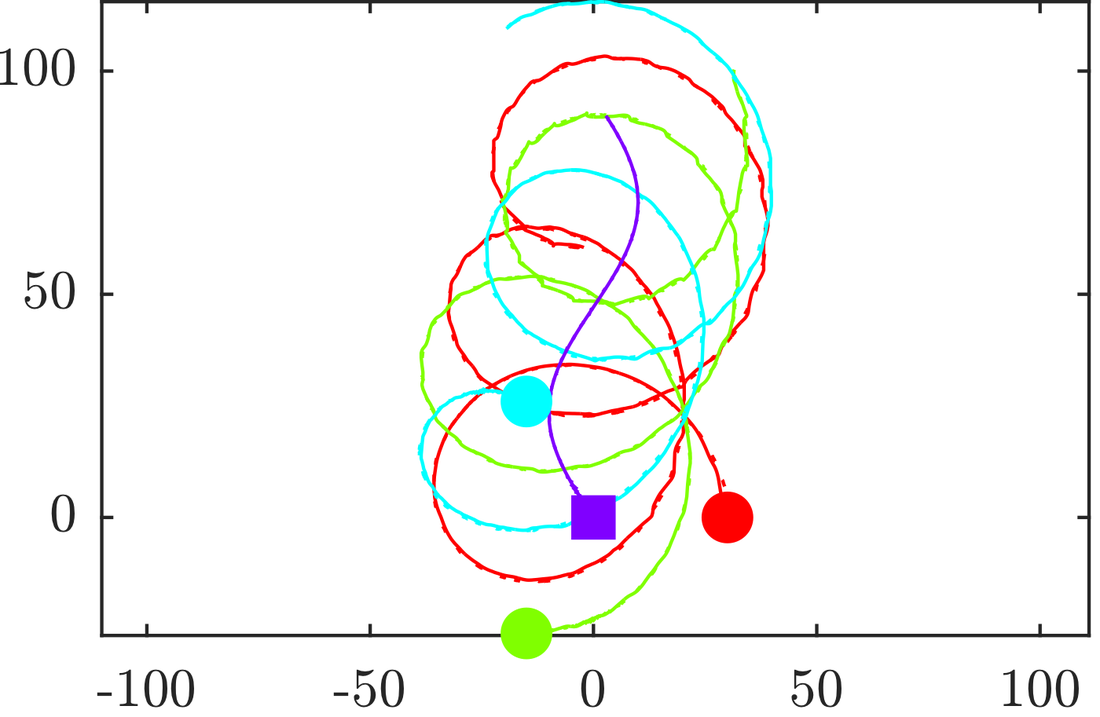
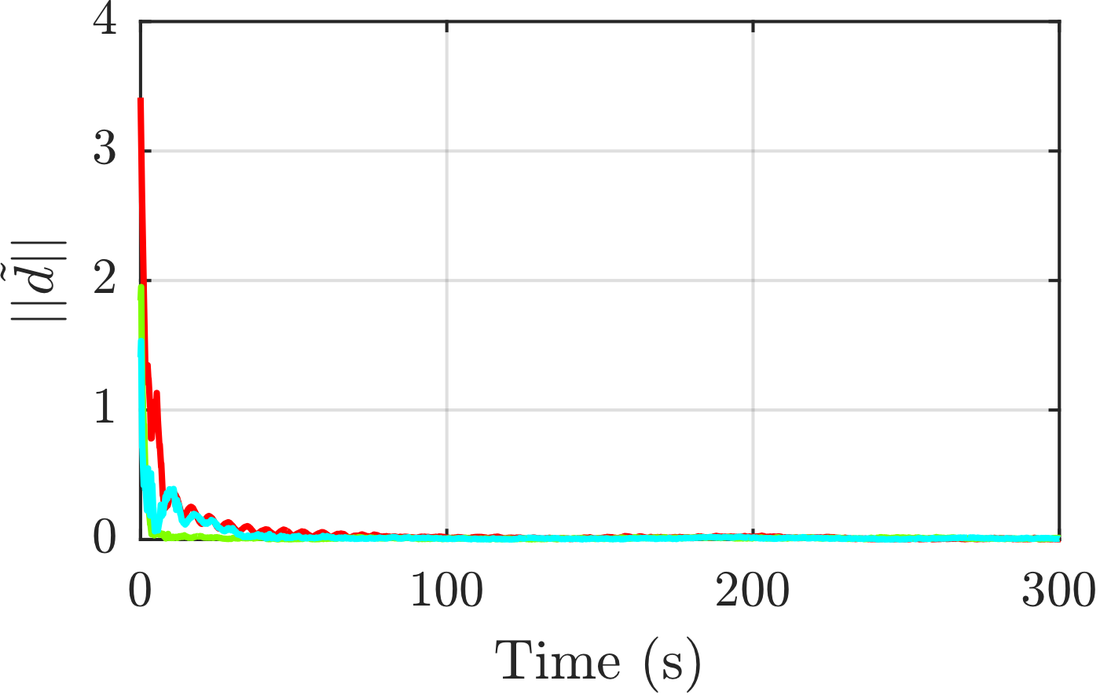
Dotted lines are the desired trajectories and solid lines the actual ones. Click any figure to enlarge it.
Avoiding obstacles
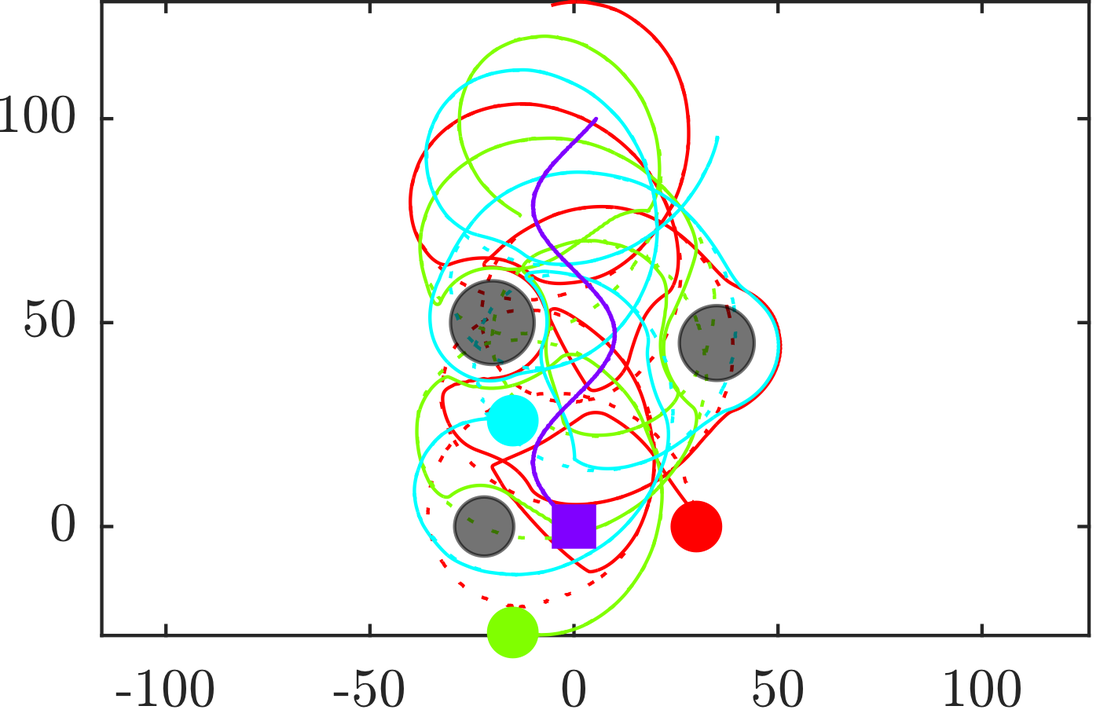
The desired circular trajectories inevitably cross obstacles. To guarantee safety, a control barrier function (CBF) is defined for each obstacle (and for each other agent) from the distance between the obstacle and a point slightly ahead of the agent’s center,
\[B_i(x) = (x_a + l\cos\theta_a - x_{O_i})^2 + (y_a + l\sin\theta_a - y_{O_i})^2 - r_i^2 ,\]where \(r_i\) is the safe distance. Using a point ahead of the center keeps the turning rate in the constraint, so the filter can steer as well as slow down. At each time step, a quadratic program finds the input closest to the nominal tracking controller that keeps every barrier function nonnegative:
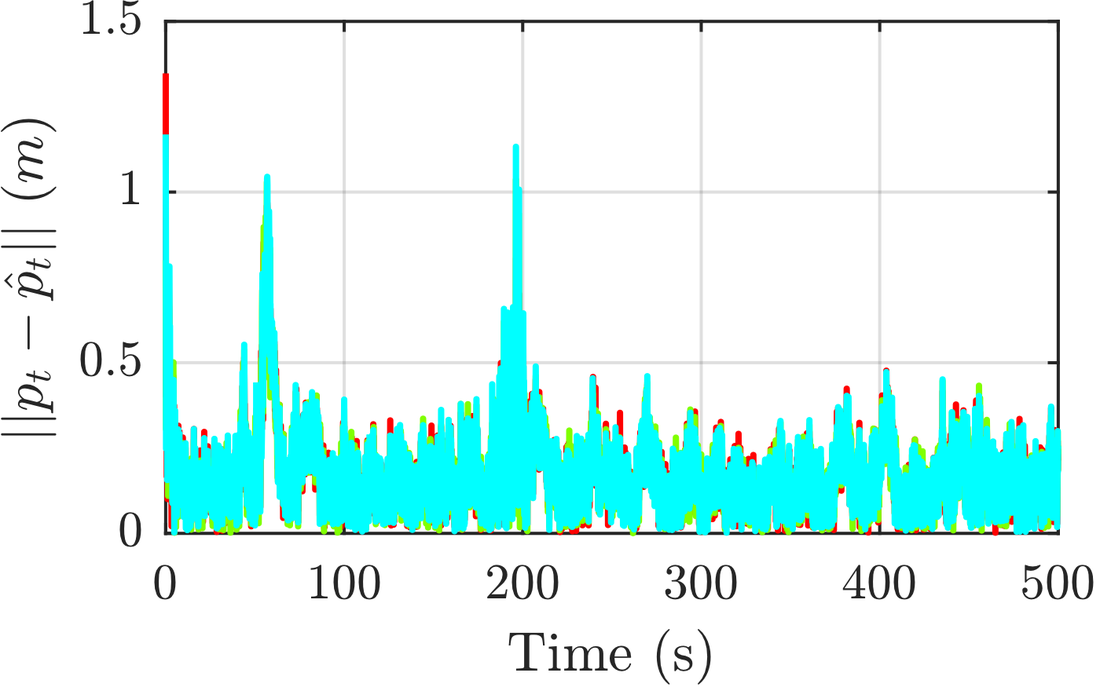
\[\min_{u} \ \|u - u_{\text{nominal}}\|^2 \quad \text{s.t.} \quad L_f B_i(x) + L_g B_i(x)\,u \ge -\alpha\big(B_i(x)\big), \quad u_{\min} \le u \le u_{\max}.\]The agents avoid all obstacles and each other while keeping the target estimation error small, with only brief spikes when an obstacle forces them away from their formation.
Takeaways
- Formation geometry matters: placing range-only sensors according to the Fisher information gives accurate localization with very few agents.
- Estimating the disturbance and feeding it back is far more effective than treating it as noise.
- A CBF safety filter adds provable collision avoidance on top of any nominal controller at the cost of a small quadratic program per step, with only a temporary loss of tracking performance near obstacles.
Citation
If you use this project in your research, please cite the following papers:
M. H. Yoosefian Nooshabadi, R. Sipahi, L. Lessard. “Stealthy Optimal Range-Sensor Placement for Target Localization.” IEEE Control Systems Letters, 8, pp. 2763–2768, 2024.
@article{nooshabadi2024stealthy,
  title={Stealthy Optimal Range-Sensor Placement for Target Localization},
  author={Nooshabadi, Mohammad Hussein Yoosefian and Sipahi, Rifat and Lessard, Laurent},
  journal={IEEE Control Systems Letters},
  volume={8},
  pages={2763--2768},
  year={2024},
  publisher={IEEE}
}
M. A. Shahraki and L. Lessard. “Spacecraft attitude control under reaction wheel constraints using control Lyapunov and control barrier functions.” 2025 American Control Conference (ACC), pp. 947–952, 2025.
@inproceedings{shahraki2025spacecraft,
  title={Spacecraft attitude control under reaction wheel constraints using control lyapunov and control barrier functions},
  author={Shahraki, Milad Alipour and Lessard, Laurent},
  booktitle={2025 American Control Conference (ACC)},
  pages={947--952},
  year={2025},
  organization={IEEE}
}