Leader–Follower Signal Temporal Logic
In a surveillance mission, a leader robot patrols a circle, and a follower must stay close enough that the team does not separate, but never so close that they collide. On top of that, the follower has its own task: it must visit a goal region within the first minute. Requirements like these, which combine logic (and, or) with time (eventually, always), are naturally written in signal temporal logic (STL). In this project, I encoded the specifications as constraints of a mixed-integer program and solved for the follower’s whole trajectory at once.
Specifications
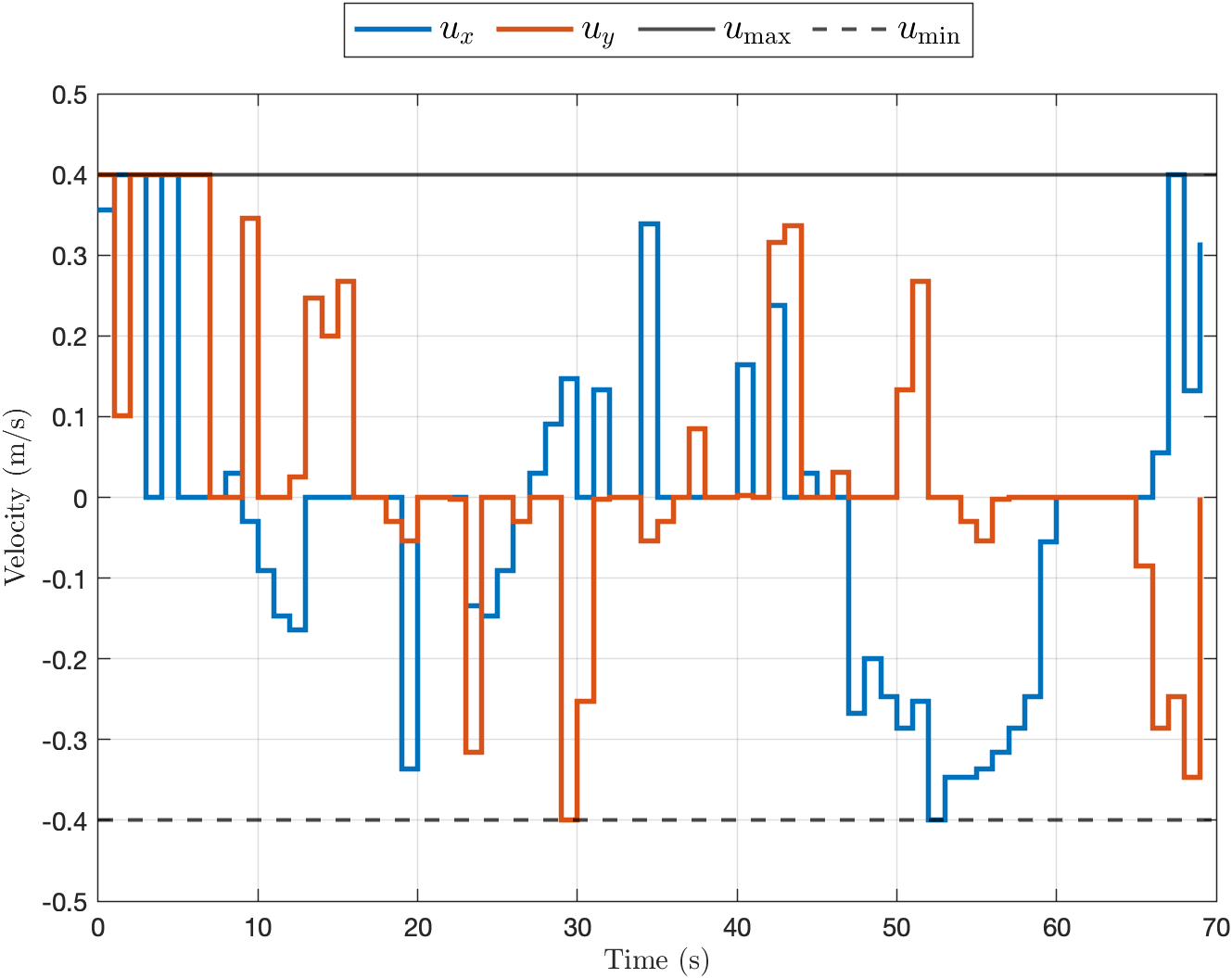
The follower is a point that moves with bounded velocity, \(x_{t+1} = x_t + u_x\,\Delta t\) and \(y_{t+1} = y_t + u_y\,\Delta t\), with \(\lvert u_x \rvert, \lvert u_y \rvert \le 0.4\) m/s. Its task is the STL formula
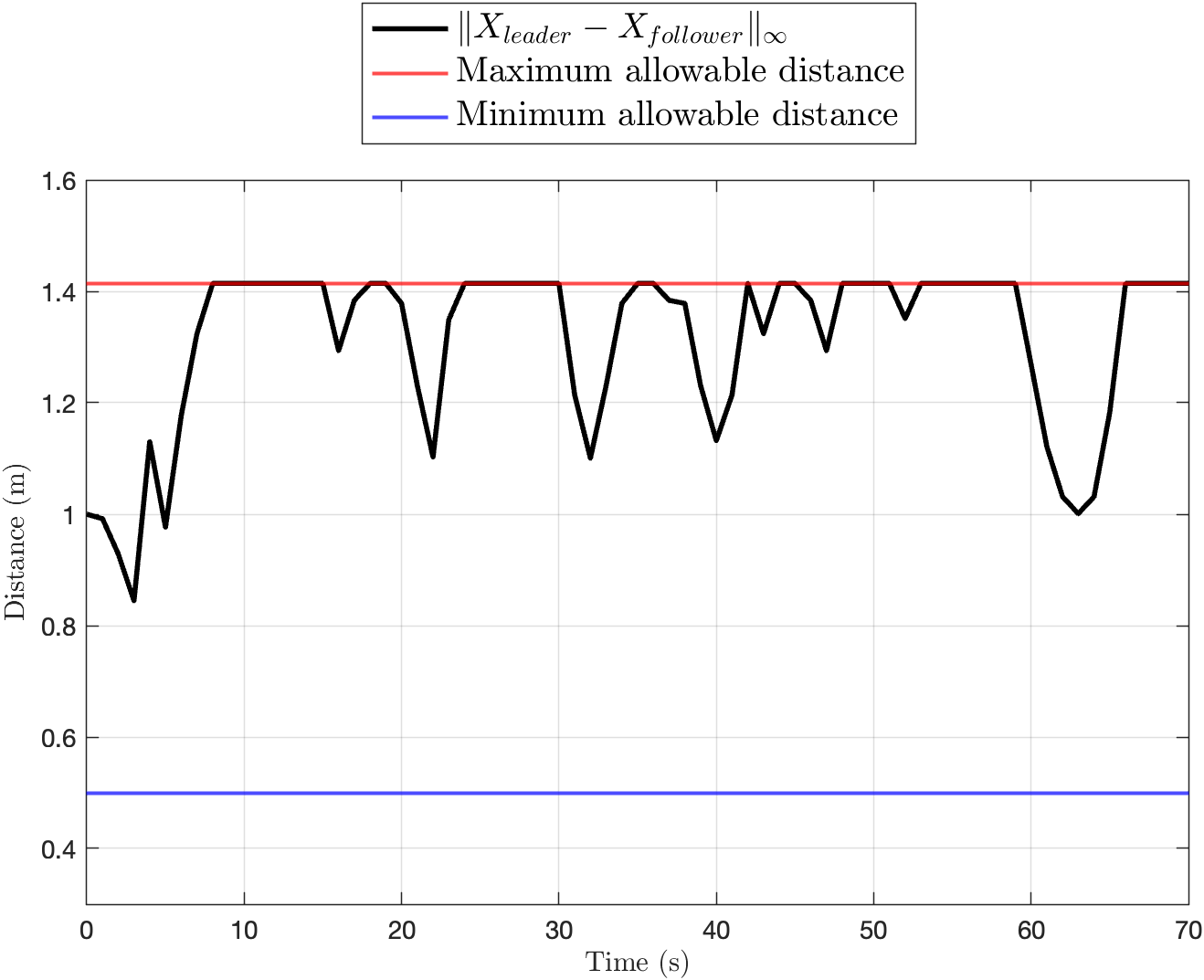
\[\begin{aligned} \varphi = {} & \mathbf{F}_{[0,60]}\big(p_f \in \text{goal}\big) \\ & \wedge\ \mathbf{G}_{[0,T]}\big(\|p_f - p_l\|_\infty \le \sqrt{2}\big) \ \wedge\ \mathbf{G}_{[0,T]}\big(\|p_f - p_l\|_\infty \ge 0.5\big), \end{aligned}\]where \(p_f\) and \(p_l\) are the positions of the follower and the leader, \(\mathbf{F}\) means eventually and \(\mathbf{G}\) means always. The goal is a rectangle, so being in it is a conjunction of four linear inequalities. Keeping the follower within a square of half-width \(\sqrt{2}\) around the leader guarantees a separation of at most \(2\) m, and staying out of the square of half-width \(0.5\) guarantees at least \(0.5\) m. The first square is a conjunction of linear constraints, but the second is a disjunction: the follower must be to the left, to the right, above or below the keep-out square.
Mixed-integer encoding
Each linear predicate \(\mu(t) \ge 0\) gets a binary variable \(z_\mu(t)\) that equals \(1\) exactly when the predicate holds, enforced with the big-M method:
\[\mu(t) \le M z_\mu(t) - \epsilon, \qquad -\mu(t) \le M\big(1 - z_\mu(t)\big) - \epsilon .\]The logical and temporal operators then become linear inequalities between binary variables. A conjunction is bounded above by each of its parts, a disjunction is bounded below by each of its parts, and eventually and always are a disjunction and a conjunction over time. Requiring the binary variable of the whole formula to equal \(1\) turns the specification into the constraints of a mixed-integer linear program over the follower’s trajectory. Among all trajectories that satisfy the specification, I looked for the one with the least control effort, \(\sum_t \big(\lvert u_x(t) \rvert + \lvert u_y(t) \rvert\big)\), and solved the problem with YALMIP and MOSEK.
Results
The follower satisfies every requirement over the whole \(70\)-second horizon: its distance to the leader stays between the two limits, its velocities stay within their bounds, and it reaches the goal region at \(t = 60\) s. To save effort, the follower moves as little as possible: it waits near the middle of the circle while the leader goes around it, staying close to the largest allowed distance, and then heads straight for the goal.
Click any figure to enlarge it.
Takeaways
- Signal temporal logic gives a precise language for tasks that mix timing and logic, such as “eventually visit the goal while always keeping a safe distance.”
- With binary variables, both the logical and the temporal operators become linear constraints, so standard mixed-integer solvers can plan trajectories that satisfy the specification by construction.
- The disjunctions, choosing on which side to pass the leader and when to visit the goal, are what make the problem combinatorial; without them it would be a linear program.